
drmarcw

/drmarcw

About drmarcw

This author has not yet filled in any details.
So far drmarcw has created 47 blog entries.

Why Liberals Should Vote Republican — Just Once

Liberals and moderate Democrats should vote Republican — just once — and make clear exactly why they are doing it. Liberals and moderate Democrats should vote Republican — just once — and make clear exactly why they are doing it. Not because they suddenly became conservatives. Not because they joined MAGA. Not because they abandoned long-held liberal beliefs on health care, abortion, climate change, or social programs. They should do it as a statement that the Democrat party is no longer recognizable to many Americans who once formed its center-left backbone. Not because they suddenly became conservatives. Not because they joined MAGA. Not because they abandoned long-held liberal beliefs on health care, abortion, climate change, or social programs. They should do it as a statement that the Democrat party is no longer recognizable to many Americans who once formed its center-left backbone.

The goal is to save the Democrat party by empowering moderates who have been silenced or politically marginalized by an increasingly radical activist left that now defines far too much of the party’s moral and political identity.  Political parties reform after losses.

Many Americans believe that the Democrat party has become incapable of correcting itself internally because the people capable of restoring balance no longer appear to control the party.

Leftists with radical viewpoints no longer merely influence the Democrat party; in many areas, they define its moral and political boundaries.  Moderate Democrats still exist, but many now fear activist backlash, donor pressure, social media outrage, and primary challenges should they openly dissent from progressive orthodoxy. Americans watched as “Defund the Police” moved from activist slogan to mainstream political discussion.  Riots were repeatedly described as “mostly peaceful.”  Masked demonstrators blocked highways, occupied campuses, vandalized businesses, intimidated opponents, and disrupted public life while political leaders often appeared reluctant to restore order decisively for fear of backlash from activist constituencies.

Many Democrat leaders now appear politically trapped by the very activist movements they once encouraged. At the same time, basic border enforcement increasingly became treated as morally suspect.  Sanctuary policies expanded. Rhetoric minimizing illegal immigration entered mainstream discourse.  Even liberal cities eventually acknowledged that unlimited migration without enforcement was unsustainable.

The Democrat party increasingly allowed ideological activism to replace practical governance. Perhaps nowhere has this shift become more alarming than in the explosion of antisemitism following October 7.

Instead of universal moral clarity following the massacre, torture, rape, kidnapping, and murder of Israeli civilians by Hamas terrorists, many Democrats and much of the media immediately pivoted toward moral relativism, rationalization, or outright hostility toward Israel itself.

Criticizing Israeli policy is legitimate.  Israelis themselves debate their government vigorously.  But questioning the legitimacy of the world’s only Jewish state is something very different.

Zionism, stripped of slogans and propaganda, is simply the belief that the Jewish people have the right to self-determination in their ancestral homeland after centuries of expulsions, persecution, pogroms, and ultimately the Holocaust.

Yet increasingly, the left insists that the one Jewish state is uniquely illegitimate.  The Jews are among the only peoples continuously tied to the same land, language, religion, and identity for more than 3,000 years.  In what historical framework does an indigenous people — conquered eleven times, yet never fully removed from its ancestral homeland and repeatedly returning to it across centuries — become redefined as “colonizers”?

Many Jews now ask whether this obsession is really about Israeli policy at all.  The answer becomes clearer when activism shifts from targeting governments to targeting Jews themselves.

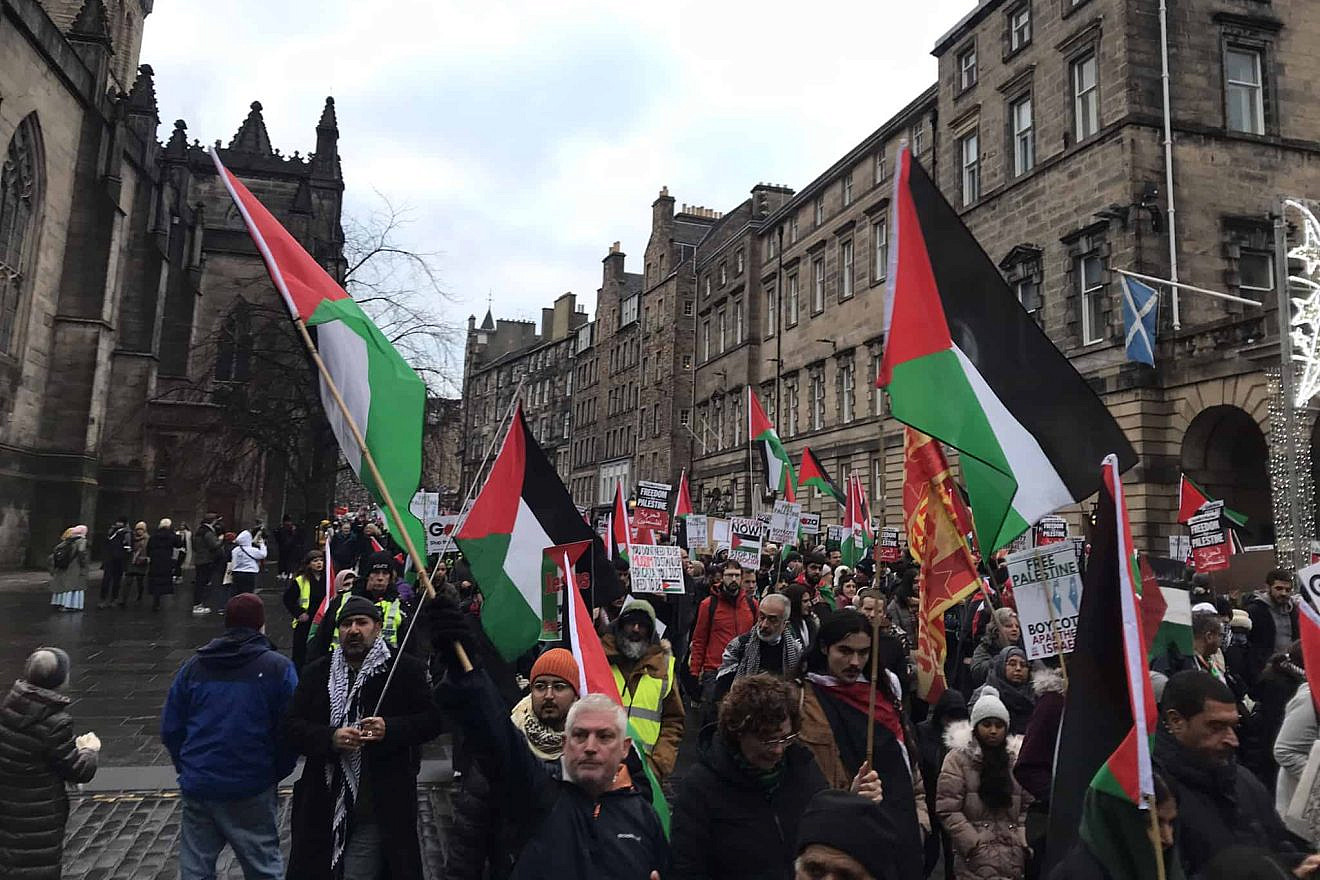
After October 7, synagogues, Jewish schools, and Jewish neighborhoods across the United States became sites of intimidation and harassment.  Protesters shouted “Globalize the Intifada,” “Go back to Auschwitz,” and “Khaybar, Khaybar ya Yahud” — a chant historically associated with anti-Jewish violence.  Demonstrators blocked entrances to synagogues in Los Angeles, Brooklyn, Manhattan, and elsewhere while chanting slogans such as “We need to make them scared.”

They targeted Jews praying, gathering publicly, or simply existing openly as Jews.

This is not an isolated incident.  It is the progression of fringe radical leftism into organized political influence inside the Democrat party itself, while the mainstream media increasingly function less as a skeptical observer and more as an ideological participant.

In New York City, mayoral candidate Zohran Mamdani alarmed many Jewish and moderate voters not only because of his socialist politics, but because his broader ideological movement increasingly appeared hostile toward Zionism, policing, and traditional liberal norms.  Mamdani’s wife publicly “liked” social media content celebrating or glorifying the October 7 murders of Israeli civilians, alarming many Jewish and pro-Israel voters.

Meanwhile in Michigan, Democrat Senate candidate Abdul El-Sayed aligned himself with “Medicare for All,” hostility toward private insurance systems, and rhetoric associated with “defund the police” activism.  He also associated himself with controversial far-left influencer Hasan Piker, who openly celebrates Hezb’allah, has used rhetoric encouraging political violence, and has repeatedly made comments about America and Israel that many moderates view as extremist and profoundly irresponsible.  Yet Democrat candidates still seek his support because of his influence among younger voters — evidence of how successfully radical ideology has been normalized among a rising generation.

There was a time when mainstream Democrat politicians would have viewed associations with rhetoric excusing terrorism, glorifying violence, or demonizing America as politically toxic.  Increasingly, that no longer appears to be the case.

Many moderates struggle to reconcile that Democrats are too insulated from scrutiny, accountability, and serious internal criticism by either the media or the Democrat party itself until it is no longer credible to insulate them.

When progressive politicians are accused of extremism, agenda-driven media often appear eager to minimize or redirect attention elsewhere.  When conservatives are accused, the presumption often appears to be immediate guilt and moral disqualification.

At the same time, massive fraud investigations in Minnesota involving billions of dollars in alleged public misuse, ongoing corruption investigations in Los Angeles, and catastrophic governance failures surrounding the Palisades fire response further erode public confidence in one-party progressive governance.

Add it all up, and the conclusion becomes difficult for many moderates to avoid: The Democratic Party increasingly appears captive to ideological activism while marginalizing moderation.

One figure can be dismissed as an outlier.  A handful as coincidence.  But when hostility toward dissent, normalization of disorder, anti-police rhetoric, antisemitism, and the courting of openly Marxist influencers whose rhetoric many Americans view as deeply anti-American and increasingly supportive of political intimidation all converge within the same political movement, one must recognize that the center of gravity inside the party has changed.

That is why many lifelong liberals may need to consider doing something politically uncomfortable: voting Republican once — not out of loyalty to Republicans or devotion to Donald Trump, but as a strategic intervention designed to empower moderate Democrats to wrestle back the soul of the Democrat party.

Healthy democracies require two sane, functioning parties capable of governing from the political center.  When one party drifts too far toward ideological extremism, electoral defeat may become the only mechanism capable of forcing introspection and course correction.

Far from being a betrayal, this may be the only remaining path back toward a Democratic Party once again capable of representing ordinary Americans in the political center and center-left.

2026-09-05T20:11:54+00:00 September 5th, 2026|

Trump’s legacy and the price of political expediency

Trump’s legacy and the price of political expediency

Sometimes a job must be finished, regardless of what happens in the next election.


America may be on the verge of making one of the greatest strategic mistakes in modern history — not because our military lacks the strength to prevail, but because our politics may lack the courage to finish the job.


For the first time in nearly half a century, the regime that has financed terrorism against the United States, Israel, our Gulf allies, and much of the West appears genuinely vulnerable.  Yet instead of asking whether this historic opportunity should be seized once and for all, too much of our political debate shifted almost immediately to gasoline prices, election polling, and partisan advantage.

America’s adversaries have long understood that democracies can be weakened by manipulating public opinion through propaganda, disinformation, and increasingly sophisticated social media campaigns.  Russia, China, Iran, and other authoritarian regimes exploit political divisions because they know democracies often lose the will to fight long before they lose the ability.


What is more troubling is that, in my view, too many influential voices within the progressive movement and much of today’s mainstream media reinforced that dynamic — not through coordination, but by framing the conflict primarily through its domestic political consequences rather than its strategic objectives.

The political message became familiar: This is “Trump’s war.”  Inflation is Trump’s fault.  Higher gasoline prices are Trump’s fault.  End the conflict, elect us, and your economic pain will disappear.


Whatever the intent, this message places enormous pressure on an administration to curtail military operations before their strategic objectives are achieved, despite the strategic victory that should naturally follow the tactical victories achieved by America and Israel since October 7.

Imagine if, during the final months of World War II, Americans had concluded that the economic sacrifices of victory had become too burdensome and demanded that President Franklin Roosevelt — or, after Roosevelt’s death, President Harry Truman — halt the war before Nazi Germany or Imperial Japan had been decisively defeated.  Previous generations understood that temporary sacrifice was often the price of achieving a lasting peace.

That is the question before us today.

Are we willing to endure temporary economic discomfort if it offers the opportunity to permanently weaken a regime that has spent nearly half a century waging war against the United States and its allies through terrorist


If political pressure forces America to settle for merely damaging the Iranian regime rather than decisively ending its ability to finance terrorism, dominate the Middle East through proxy armies, and ultimately obtain nuclear weapons, historians may conclude that political expediency will accomplish what Iran’s military never could.

Since 1979, Iran has financed and armed Hezb’allah, Hamas, Palestinian Islamic Jihad, Shiite militias in Iraq, the Houthis in Yemen, and other proxy organizations responsible for attacks that have killed Americans and countless civilians throughout the Middle East.  Every president since Jimmy Carter recognized the threat.  Each sought to contain it by different means — sanctions, diplomacy, deterrence, covert action, or limited military force — but none fundamentally ended Iran’s ability to project power through terrorism and proxy warfare.

Then something extraordinary happened.

For perhaps the first time in decades, Iran’s strategic position appeared genuinely vulnerable.  Its proxy network had been severely weakened.  Hezb’allah had suffered devastating losses.  Hamas had been crippled militarily.  Syria had become a far less reliable partner.  Iran itself found its military infrastructure under unprecedented pressure.

Victory was finally within reach.

Whether one agrees with President Donald Trump’s decision or not, he demonstrated something few political leaders willingly do: He appeared prepared to risk his presidency, his political future, and ultimately his historical legacy in pursuit of what he believed was a rare opportunity to permanently weaken the world’s leading state sponsor of terrorism.

History will ultimately judge whether that decision was correct.  What cannot honestly be disputed is that it required accepting extraordinary political risk.

Political expediency is not a Democrat vice or a Republican vice.  It is democracy’s oldest temptation.  The question is whether, at moments of historic consequence, statesmen are willing to rise above it.

In this instance, I believe that today’s progressive movement and too many Democrat leaders have allowed short-term political advantage to eclipse what should be a historic strategic opportunity.  Rather than asking how the United States might permanently weaken the world’s leading state sponsor of terrorism, much of the public conversation became focused on the next election.

That same political calculation can also be seen, in my view, in the willingness of many Democrat leaders to embrace or tolerate candidates whose rhetoric and positions would have been politically disqualifying for much of our nation’s history.  The Democrats’ nomination of Graham Platner for the U.S. Senate in Maine, despite his publicly reported remarks, raises legitimate questions about where those standards now lie.  Among the statements attributed to Platner are “Why don’t black people tip?,” (2013); his response to a video of an American soldier killed by the Taliban, calling him a “dumb MF” who “didn’t deserve to live” (2019); and, perhaps most strikingly, his 2021 declaration: “I got older and became a communist.”

Nor is Platner alone. Texas congressional candidate Maureen Galindo proposed converting an ICE detention facility into a prison for “American Zionists.”  New York congressional candidate Darializa Avila Chevalier publicly joked that after forgetting napkins, she “just wiped my hand on the American flag behind me.”  Representative Rashida Tlaib (D-Mich.) has repeatedly used the phrase “from the river to the sea,” while many prominent Democrat leaders have been reluctant to unequivocally repudiate that slogan or others such as “globalize the intifada.”

Taken together, these examples raise legitimate questions about whether maintaining partisan unity has too often taken precedence over drawing clear moral boundaries.  More broadly, they suggest that rhetoric and positions previous generations of Americans would have regarded as politically disqualifying are now increasingly tolerated — or, at times, embraced — in the pursuit of electoral success.

Political parties are ultimately judged not only by the candidates they reject, but also by the candidates they elevate.

If history concludes that victory was within reach and America chose political expediency instead, the greatest tragedy will not be that our military lacked the strength to prevail.  It will be that our politics lacked the resolve to finish what history unexpectedly placed within our grasp.

Political expediency may yet accomplish what Iran never could.

History has not yet been written.  Let us prove that America’s political courage is equal to its military strength.

2026-08-29T14:12:05+00:00 August 29th, 2026|

The Myth of the ‘Imminent Threat’

American Thinker 

The Myth of the ‘Imminent Threat’

Iran has been at war with the United States for a long time.

For nearly half a century, the Islamic Republic of Iran has treated its conflict with the United States as a war.  The real question is not whether Iran threatens America, but whether Americans are willing to recognize that reality.

A familiar argument has been repeated by politicians and much of the mainstream media: Iran posed no “imminent threat,” and therefore military action against it was unjustified.  But this claim ignores the true nature of the conflict between the United States and the Islamic Republic.

For many advancing it, the argument is less a strategic assessment than a political one — repeated to obscure danger in the hope of undermining the policy and weakening President Trump and Republicans ahead of the coming election cycle.

Iran’s war against America began on November 4, 1979, when Islamist revolutionaries stormed the U.S. embassy in Tehran and held 52 American diplomats hostage for 444 days — cementing hostility toward the United States as a defining principle of the new regime.

The debate over whether Iran poses an “imminent threat” misses the broader reality. The United States has been under sustained attack from the Iranian regime for nearly half a century, and Iran’s hostility toward America — measured in lives lost, resources expended, and instability exported across the region — is beyond dispute.  The regime has never hidden its intentions, repeating its familiar mantra, “Death to America,” while pursuing a strategy of indirect warfare through proxies and militant allies.

Iranian-backed forces carried out the 1983 bombing of the U.S. Marine barracks in Beirut that killed 241 Americans and the 1996 Khobar Towers bombing in Saudi Arabia that killed 19 U.S. servicemen.  Iran’s Revolutionary Guard later armed and trained militias in Iraq that deployed specialized roadside bombs responsible for a significant share of American casualties during the Iraq War.

Beyond direct attacks on Americans, Tehran has spent decades extending its influence across the region — dominating Lebanon through Hezb’allah, influencing Iraq through allied militias, and constructing what its leaders call a “ring of fire” of armed proxies surrounding Israel.  These networks allow Iran not only to threaten Israel, but also to challenge American interests and destabilize governments across the Middle East.

Iran’s war also reaches beyond the battlefield.  In 2011, U.S. authorities disrupted a Quds Force plot to assassinate the Saudi ambassador in Washington, D.C. — by bombing a restaurant in the American capital.  More recently, a Pakistani national is currently in Washington facing charges for allegedly attempting to assassinate Donald Trump, claiming that Iranian operatives threatened his family if he refused to cooperate.

Meanwhile, Iran has continued advancing toward strategic capabilities that would dramatically shift the balance of power.  U.S. and international analysts estimated that Tehran was only weeks away from producing weapons-grade nuclear material when American B-2 bombers struck the Fordow and Natanz enrichment facilities last June.  At the same time, Iran has spent years expanding one of the largest ballistic missile programs in the world, steadily increasing the range and sophistication of systems that already reach eastern Europe and are projected to threaten western Europe — and potentially the eastern seaboard of the United States.

Had the world’s leading state sponsor of terrorism achieved nuclear capability and reliable long-range delivery systems, the deterrent immunity such weapons provide would have dramatically constrained America’s ability to project power and influence around the globe.

Is that not the very definition of an imminent threat?

If the terrorists of September 11 had been detected while their planes were taking off or still approaching their targets, would anyone seriously argue that the danger was not imminent simply because the planes had not yet reached the buildings?  At what distance would the threat suddenly become real — thirty miles?  Ten miles?  One?

An enemy does not suddenly become dangerous at the moment of impact.

One would have to suspend reality to believe Iran posed no imminent threat.  Clearly, it did.

Authoritarian regimes routinely probe their adversaries for weakness to exploit.  The familiar adage that weakness invites aggression is repeated so often because history continues to confirm it.  For revolutionary regimes like Iran’s, confrontation with the West is not merely opportunistic, but ideological, making perceived weakness especially tempting to test.

The lesson was illustrated dramatically during the very crisis that launched the modern conflict between Iran and the United States.  For 444 days, Iran held American diplomats hostage while negotiations dragged on through the final year of the Carter administration.  Yet the hostages were released on January 20, 1981 — minutes after Ronald Reagan was sworn in as president, ending the crisis the moment a new administration widely perceived as tougher took office.  The symbolism was unmistakable.  Iran had been willing to defy the United States for more than a year, but it chose to resolve the crisis the moment the balance of perceived American power shifted.

Over the following decades, this relationship between American policy and Iranian behavior has often followed a predictable cycle.  Periods when American strategy projects strength tend to restrain Iranian aggression, whereas periods of hesitation or strategic retreat encourage Tehran to expand its activities.  Each time deterrence weakens, Iran tests the limits again.  The past decade illustrates this dynamic clearly.  The 2015 nuclear agreement negotiated during the Obama administration lifted major sanctions in exchange for limits on Iran’s nuclear program.  The agreement provided Tehran with significant economic relief, which the regime used to expand its regional proxy network and military activities across Lebanon, Syria, Iraq, and Yemen.

The Trump administration withdrew from the agreement and implemented a campaign of economic pressure aimed at restricting Iran’s ability to finance those networks.  Since 2021, however, under Biden, Iranian-backed militias have again intensified attacks across the region while Tehran continues strengthening its proxy relationships and military capabilities, tragically exemplified by the October 7 massacre.

Iran’s ambitions have never been limited to the Middle East.  Tehran has become an important node in a broader anti-Western alignment linking the Iranian regime with Moscow and Beijing.  Iranian drones have been supplied to Russia for use in Ukraine, where they are routinely used to attack civilian infrastructure.  At the same time, China has continued purchasing large quantities of Iranian oil — often outside the formal sanctions system — providing the regime with critical revenue that helps sustain its military and proxy operations.

Disrupting Iran’s military and economic infrastructure, therefore, has implications far beyond Tehran.  Restricting Iran’s ability to export oil weakens a supply channel that has helped fuel China’s rise.  Preventing Iran from supplying drones limits the tools Russia uses to terrorize Ukrainian civilians.  Constraining the regime’s regional proxy networks reduces the instability that has plagued the Middle East for decades.

In that sense, confronting Iran does more than neutralize a single adversary.  It alters the strategic environment across multiple theaters, shifting the balance of power toward the United States and its allies.  It also weakens the ideological momentum of radical Islamist movements — both in the region and in the West — by demonstrating that the regime long claiming to lead that struggle can, in fact, be decisively defeated.

Trump is not starting a war.  He is ending one.

iconiconiconiconiconiconicon

2026-03-15T22:50:27+00:00 March 15th, 2026|

The Reckoning of the West


Dr. Marc Weisman. Credit: Courtesy.
Dr. Marc Weisman
Dr. Marc Weisman is a physician, health-care leader, and medical director who writes political commentary.
January 1, 2026


The Reckoning of the West

The problem is not radical Islam alone, but the convergence of radical Islamist ideology with Western institutional weakness and deliberate amplification by foreign adversaries.


History is filled with ignored warnings, but only rarely does it deliver a moment so clarifying that denial becomes more dangerous than confrontation. Fifteen years ago, I argued that radical Islam threatens Western civilization not through military conquest, but through “slow jihad”: demographic pressure, moral confusion, and normalization within open societies. In its early stages, this process was sustained by institutional guilt and a media culture that reflexively equated scrutiny of Islamism with bigotry. As Muslim populations grew in key regions, moral paralysis gave way to political calculation, as politicians increasingly courted Muslim votes, often at the expense of assimilation, social cohesion, and liberal norms.

Long-developing civilizational pressures rarely provoke action until a single, undeniable shock crystallizes them. That shock came on Oct. 7, 2023. It marked the moment when denial became untenable—not only for Jews, who have long understood the pattern, but for the broader West. The atrocities themselves were barbaric enough. What followed—the celebrations, justifications, and moral inversions across Western capitals—was something more: a revelation. The question is no longer whether the warnings were correct, but whether this moment represents the point at which the West finally acts while it still can.

For decades, liberals and the left stigmatized a defense of Christendom or acknowledgment of a civilizational clash with political Islam as veiled far-right bigotry. That rhetorical shield is now collapsing as global events strip away denial, expose the scale of radical Islam, and sharpen the contrast so starkly that the Judeo-Christian world is at last beginning to recover its voice.

The barbarity of Oct. 7 was neither abstract nor ambiguous. Hamas deliberately targeted civilians in their homes and at a music festival. Families were murdered together. Women were raped. Parents were forced to witness the killing of their children. These were not acts of war but acts of ideological ritual.

What followed in the West was as revealing as the attack itself. University campuses across the United States became sites of Jewish intimidation and celebration of violence. Protesters chanted slogans calling for Israel’s destruction and the “globalization of the intifada.” Campus buildings were blockaded. Jewish students were warned to avoid certain areas “for their own safety.” Student groups openly declared that Zionists were unwelcome—using “Zionist” as a newly acceptable proxy for Jew—as administrators invoked “free expression” while Jewish students were excluded from academic life.

Across Europe, the pattern was more advanced. In the United Kingdom, authorities suppressed criticism of Islamism while accommodating Islamist demonstrations. Grooming-gang rape scandals long suppressed in the media—documented in multiple investigations and involving thousands of working-class girls—continued to surface, exposing decades of institutional cowardice driven by fear of appearing “Islamophobic.” Comparable failures have unfolded in France, Germany, Norway, Belgium and Sweden. Oct. 7 did not create these realities; it forced their recognition.

In the weeks following Oct. 7, the jihad was unmistakably globalized, exported into Western cities and campuses where demonstrations crossed from protest into intimidation and celebration of violence. That legitimization emboldened escalation until violence became inevitable, and many in the West began to realize this was more than they bargained for.

What is ultimately at stake is not Israel alone. Israel is the front line, but the target is far larger: the Judeo-Christian civilization that gave rise to modernity itself—individual rights, equality before the law, secular governance, scientific inquiry and moral accountability. Oct. 7 was not merely an assault on Israel; it was an assault on the ethical foundations of the West.

The urgency is not emotional; it is structural. Civilizations rarely collapse suddenly; they erode over time. One of the clearest indicators of civilizational decline is demographic trajectory. Trends in Europe and North America cannot be ignored. Time does not favor the West. Muslim fertility rates in Europe remain well above replacement level, while native European birth rates have collapsed. In the United States, overall fertility has fallen to historic lows, even as populations carrying illiberal norms grow more rapidly. Demographics are not destiny, but they are momentum.

The problem is not radical Islam alone, but the convergence of radical Islamist ideology with Western institutional weakness—and with deliberate amplification by foreign adversaries. Islamist regimes in the Middle East, along with Russia and China, exploit social media, bots, and online propaganda to accelerate radicalization, deepen polarization, and undermine social cohesion within open societies.

For years, Western elites insisted this threat was imagined and, when it became undeniable, that it was marginal or provoked. Oct. 7 tore away the protective cloak that had long insulated radical Islamism from scrutiny. Within hours, murder was reframed as “resistance,” victims as oppressors and barbarism as grievance, revealing an ideological alignment that could no longer be denied.

Words matter because they prepare the ground for action. Western democracies already understand that words can kill; yet when eliminationist logic is voiced through Islamist language, the West suddenly discovers an absolutist devotion to free expression. The long era of debating whether a substantial faction of Islam poses a genuine danger to the West is mercifully over.

What distinguishes this moment from all prior warnings is that the balance has begun to shift. Israel’s post-Oct. 7 victories have punctured the myth of Islamist invincibility; the Chanukah mass shooting on Bondi Beach and the public backlash against Australia’s leadership exposed the cost of appeasement; and in Britain, figures once dismissed as pariahs—Nigel Farage, even Tommy Robinson—now command growing support, while Douglas Murray and other defenders of Western civilization have moved firmly into the mainstream. Across Europe, governments have moved from rhetoric to action: Hungary, under Viktor Orbán, has fortified its borders and reasserted a Christian national identity; France has tightened immigration, conditioned welfare, and dismantled Islamist organizations; Sweden has slashed asylum intakes. Germany has accelerated deportations and begun expelling radical imams, and Italy, led by Giorgia Meloni, has curtailed NGO rescues. Iran and its proxies are weakened, Saudi Arabia again edges toward peace with Israel, and the West, albeit shaken, has begun to recover its voice.

Resistance is not bigotry. Lawful self-preservation is not persecution. What’s at stake is the survival of modernity itself and the Western civilization that produced it. Cultural pluralism cannot mean the institutionalization of parallel societies governed by incompatible norms.

If this moment is to mean anything, it must translate into policy. The West need not abandon liberalism to defend itself, but it must rediscover its boundaries. Deportation of radical clerics, which is already underway in Germany, should become standard practice across Western democracies. Assimilation must be restored as a requirement of residency. Parallel societies cannot be tolerated indefinitely within nations founded on shared civic norms. None of this is racial. None of it targets faith. It is the ordinary exercise of sovereignty—long deferred, but entirely lawful—and the minimum necessary for a civilization that intends to survive.

Civilizations rarely receive infinite chances. The danger is no longer abstract; it is visible, vocal, and violent. Oct. 7 and its aftermath may prove to be the moment when the West finally stops mistaking tolerance for virtue and denial for compassion.

History will not ask whether the West was warned. It will ask whether it acted.

2026-01-24T00:22:40+00:00 January 24th, 2026|

The Trump Peace Plan: Promise, Pause, or Illusion

Spectator logo

by October 14, 2025, 10:04 PM
 

The Mirage of Acceptance

On Oct. 7, 2023, the world witnessed evil in its purest form. Hamas terrorists stormed into Israel from Gaza, murdering more than 1,200 people — men, women, children, and the elderly — in acts of barbarity. Families were burned alive, women raped, and children mutilated before being executed. Hundreds were dragged into captivity. It was the deadliest day for Jews since the Holocaust. (RELATED: Two Years Later, ‘Much of the World No Longer Remembers Oct. 7’)

Hamas’s acceptance is not an embrace of peace; it’s a maneuver for survival.

Nearly two years later, a fragile calm is emerging. Hamas has, in its habitual fashion, accepted Phase I of the Trump Peace Plan — not from conviction but from calculation. A flat rejection would invite annihilation, so it has done what it always does: stall, obfuscate, and concede just enough to survive. This limited “acceptance” is likely a tactical pause meant to appease Washington and buy time, not a step toward reconciliation. (RELATED: Oct. 7: A Dark Anniversary)

Hamas’s acceptance is not an embrace of peace; it’s a maneuver for survival. The group has not agreed to disarm, end its holy war, or recognize Israel as a Jewish state. Its leaders speak not of reconciliation but of “strategic patience,” a euphemism for regrouping. The only logical conclusion from this is that they have not changed their stripes.

Global Relief v. Global Delusion

The Trump Plan’s 20 points are clear, even if logistics are still unfolding. The world, weary of war and desperate for stability, now risks confusing a ceasefire with surrender and the paperwork of peace with actual peace. Nations just weeks ago paralyzed by moral equivocation — Britain, France, Spain, Canada, Australia, and others — now rally behind the plan’s humanitarian first phase, which promises the return of hostages and international oversight in Gaza.

But Phase I was the easy part — symbolic, humanitarian, photogenic. The real test lies ahead. Phases II and III require Hamas to permanently disarm, dismantle its military wing, and forfeit any role in Gaza’s governance. Arab partners must rebuild Gaza while ensuring that the same terrorists who destroyed it cannot bleed back into power under new names or flags. (RELATED: So Let’s Say Israel Agrees to Full Withdrawal and All Hamas’s Demands)

If the international community mistakes this pause for progress — or allows Hamas to spin its survival as “resistance rewarded” — the entire framework will collapse.

The Narrative War

Hamas’s most potent weapon has never been its rockets — it is its narrative: a toxic blend of victimhood, martyrdom, and moral inversion.

Hamas’s most potent weapon has never been its rockets — it is its narrative: a toxic blend of victimhood, martyrdom, and moral inversion. For decades, Hamas has convinced millions, especially within Western academia and media, that its genocidal campaign is “resistance.” Now, in the aftermath of military defeat, it seeks to weaponize that same narrative to claim that Israel was “forced to negotiate” and that “resistance brought results.” (RELATED: Post-Identity Antisemitism: The New Obsession With Israel)

If this lie takes root, it will embolden radicals from Europe to the United States, convincing them that violence works. Jihadists in the West will be newly inspired, and every antisemitic attack in Paris, London, Toronto, Sydney, or New York — every chant on a Western campus, every Israeli and American flag burned at home and abroad will trace its moral lineage to this illusion of Hamas’s “victory.” It is therefore imperative that the end result of the Trump Peace Plan must include an indisputable decimation of Hamas in the Middle East.

The Gaza Trap

Under the Trump Plan, an Arab-led coalition — Egypt, Jordan, the UAE, and Saudi Arabia — will oversee Gaza’s security and reconstruction. In theory, it is sound. In practice, it could be perilous.

If Hamas or Islamic Jihad fighters provoke violence from Gaza’s ruins, Israel’s ability to respond will be constrained. Any Israeli strike that injures Arab peacekeepers could spark a diplomatic crisis — or worse. To prevent that, the U.S. and its allies must ensure that any Arab presence operates under ironclad terms: full coordination with Israel, zero tolerance for Hamas infiltration, and authority to dismantle terror networks without political interference. Anything less would turn Gaza into a powder keg wrapped in a peace ribbon.

The Hard Part — and the Only Path Forward

The Trump Peace Plan is built on realism: peace through strength, coexistence through accountability. Israel’s acceptance was strategic, not naïve. It understands that only Hamas’s defeat could create the foundation for genuine reconstruction.

Phase I — hostage return and humanitarian relief — is a moral success, but the world must not mistake compassion for closure. The next stages — demilitarization, deradicalization, and reconstruction — will determine whether this is truly peace or merely a pause.

The Palestinian people deserve dignity and self-rule, but that cannot coexist with an ideology rooted in Jew-hatred and jihad. The Arab states stepping into Gaza now bear a historic responsibility: to ensure that Hamas never rules, recruits, or re-arms again.

The United States and Israel must guarantee that outcome — not through speeches or sanctions, but through unwavering enforcement. Phase I ended the fighting; only Hamas’s unconditional surrender — whatever euphemism it chooses — can end the war.

READ MORE from Marc Weisman:


2025-11-23T17:11:41+00:00 November 23rd, 2025|

New York’s warning to America

        Dr. Marc Weisman is a physician and writer.
 
New York’s warning to America

It is no political accident that New York City elected a mayor who openly embraces anti-Western and antisemitic positions. It is the predictable result of a long cultural drift in which mainstream liberals ceded their universities, newsrooms, schools and corporate bureaucracies to activists who disdain the very civilization that made their prosperity possible. A society that forgets its blessings becomes easy prey for those determined to dismantle them.

New York City once welcomed dreamers from around the world, blending cultures through genuine inclusion without sacrificing the American experiment. That mosaic helped make America great—distinct pieces keeping their heritage yet fitting into a unified whole. But as love for that whole—America itself—has faded under the modern left’s identity-politics framework, the mosaic has begun to break apart; its pieces no longer blend, growing more insular and distant rather than uniting in a common purpose.

In recent years, the city’s social fabric has unraveled. Police have been sidelined, campuses have erupted in pro-Hamas demonstrations, and political leaders routinely signal that enforcing the law is optional.

The shift is unmistakable: Columbia University’s encampments left Jewish students afraid to walk their own campus; a CUNY Law School commencement speaker used her platform to denounce the New York City Police Department and praise anti-Israel activism; and the Manhattan district attorney declined to prosecute major crime categories while aggressively pursuing an unprecedented case against Donald Trump, which was widely criticized as politically driven. These moments are not isolated; they define the city’s new public ethos.

 As those foundations erode, Manhattan has embraced the oldest political illusion in the book: that socialism can give everyone everything.

In any city, a mayor-elect’s openly antisemitic rhetoric would be alarming, but in New York—home to the largest Jewish community outside Israel—it should have been politically disqualifying.

This transformation did not begin in New York; it simply surfaced there first. Over decades, universities, public schools, major media outlets and corporate bureaucracies drifted away from the foundational principles that once unified the country. As researchers at Heterodox Academy have shown, campuses became ideological monocultures that punished dissent. Critical Race Theory replaced traditional civics, casting the West not as a defender of liberty but as an engine of oppression.

These ideas migrated from the campus into mainstream institutions, where activism replaced inquiry and merit was recast as privilege. What began as campus theatrics and media slogans became the Trojan code that rewrote these institutions from within. The result is a generation fluent in America’s flaws yet unfamiliar with the principles that safeguard their freedom: individual rights, free speech, due process and constitutional norms.

A 2024 Harvard CAPS/Harris Poll illustrates the consequence: 51% of Americans aged 18 to 24 viewed the Hamas-led terrorist attacks in southern Israel on Oct. 7, 2023, as “justified.” This is the predictable outcome of a cultural apparatus that teaches what to condemn but never what to cherish.

As these internal fractures widened, foreign adversaries—from Islamist propagandists to Chinese and Russian influence networks—flooded American social media with disinformation engineered to deepen every divide. America created the cracks; its enemies merely widened them.

As intersectionality rose, Kimberlé Crenshaw’s theory that identity labels such as race, ethnicity, gender identity and sexuality each add another layer of oppression became the left’s new moral compass. Virtue was assigned to the “oppressed,” guilt to the West cast as the ultimate oppressor, and equality gave way to “equity,” a doctrine demanding unequal treatment to impose equal outcomes.

Through this lens, ideologies openly hostile to the West—from radical environmental extremism to Islamism—were recast as authentic resistance. Even Europe’s near-civil conflict, born of clashing cultures, is dismissed by American liberals who insist the West is the true villain, even when the alternative is violent, intolerant, misogynistic, antisemitic Islamists. In this inversion, persecutors become victims, and haters become heroes.

Back in America, radicals did not storm liberal strongholds. Liberals opened the gates.

Universities became echo chambers because scholars stopped defending inquiry.
Prosecutors reframed crime as a product of society because liberals insisted offenders were too mistreated to be blamed. Journalists abandoned impartiality because audiences rewarded activism. And Democratic leaders shrank from confronting extremists—fearing social-media mobs, primary challengers and ostracism from the very forces and voting blocs they had empowered.

Believing that they could manage the storm, liberals tolerated its growth. But the radicalism they indulged soon consumed the institutions they abandoned.

A culture that trains its young to resent the values that safeguard their freedom eventually pays a price. The rule of law, merit, free expression and even the presumption of innocence have been recast as instruments of oppression, particularly when applied to anyone right-of-center. Once those foundations erode, the society built upon them falters. In this environment, the new mayor’s blend of socialism, Islamism and antisemitism became not a disqualifier but a badge of ideological purity within a worldview that casts Israel as a colonial offender despite millennia of Jewish presence in the land, and the West as an oppressor.

The question is not only how New York elected this mayor, but whether America can rebuild the common ground it has allowed to erode. Conservatives cannot repair what liberals permitted to decay; they do not control the universities, the media, the schools or the cultural machinery shaping the next generation. They did not construct the ideological framework governing the left and cannot dismantle it.

Only liberals can reclaim their movement from the radicals they enabled. And only liberals and conservatives working together can rebuild a shared cultural center strong enough to withstand ideological extremism. Whether Americans choose to reassert those principles will determine if this moment becomes a turning point or a point of no return.

For the sake of Gen Z and those who follow, restoring that shared center is essential.

Like ancient Troy, America’s gates were not breached; they were opened from within.

It is through that open gate that the mayor’s rise must be understood. His victory is a warning not only for New York but for the entire country. Foreign adversaries may exploit our divisions, but the deeper danger is internal: the nation’s universities, media and cultural elites abandoned their identity and mission, creating the very vulnerabilities our enemies now weaponize. A nation that teaches its heirs to resent their inheritance will eventually watch them give it away.

The responsibility to repair this lies with liberals and Democrats willing to confront the extremism they once indulged. Should moderate liberals regain their footing, they will find natural allies in conservatives who still believe in the West’s core principles—giving America one final chance to right the ship.

2025-11-23T17:02:18+00:00 November 23rd, 2025|

Israel: The canary in the West’s coal mine

American Thinker 

Keeping up with the destruction of America

August 28, 2025


As Hamas nears defeat, the world seems determined to stop Israel — yet the stakes go far beyond Gaza.  The West is ignoring the warning signs: Israel’s survival is a test for the survival of Western civilization.

Even President Donald Trump — by far Israel’s strongest ally since October 7, more than any other leader in the world — now finds that as Hamas nears defeat, the global drumbeat for a ceasefire, which is nothing less than a demand for Israel’s surrender, has become deafening.  What was once framed as “humanitarian concern” has morphed into political pressure aimed not at Hamas, the aggressor, but at Israel, the victim.  The closer Israel comes to eliminating a genocidal terror organization, the louder the world insists that it must stop.  This is not a call for peace; it is a call for capitulation.

History underscores the danger.  In every war since Israel’s founding, international pressure has forced Israel to halt before destroying the Islamist threat.  This threat has only grown, metastasizing beyond the Middle East and into the West.

Yet let us assume, against the weight of history, that Israel is allowed total victory over Hamas.  What then?

The West clings to the illusion that peace will follow Hamas’s destruction, as if Palestinian society secretly longs for coexistence.  This is dangerously naïve.  Hamas is not a fringe movement; it reflects a culture steeped in Jew-hatred — taught in schools; preached in mosques; and broadcast daily across Gaza, Judea, and Samaria.  Polls show that over 85% of West Bank Palestinians prefer Hamas to the Palestinian Authority.  And the P.A. is no moderate alternative: It preaches the same antisemitism, only in a suit rather than fatigues, seeking Israel’s destruction in stages rather than all at once.

Every ceasefire, withdrawal, and “confidence-building measure” has failed.  You cannot build peace on hatred.  You cannot entrust governance to a population that glorifies murder.

So let us examine the four most likely options for the ‘day after.’

  1. Ceasefire = Surrender in Disguise

A premature truce before Hamas’s destruction would hand Iran and Hezb’allah a propaganda victory, proving yet again that terrorism outlasts Israeli resolve and that the West will bail jihadists at the brink of defeat.

  1. Palestinian Authority Control = Poison Renewed

Handing Gaza to the P.A. is no solution.  For decades, the P.A. has indoctrinated children with Jew-hatred and funded murder through its “pay for slay” program.  Gaza under the P.A. would be Gaza poisoned anew.

  1. Forced Emigration & Annexation = Decisive but Explosive

International law permits relocating a hostile population posing an existential threat.  Annexation with resettlement would eliminate the terror base permanently — but at the cost of massive international backlash and diplomatic isolation.

  1. Voluntary Emigration & Arab-Led Reconstruction = The Least Bad Option

Roughly 44% of Gazans say they would leave if given the chance.  With U.S. and Gulf support, Arab states aligned through the Abraham Accords could oversee the reconstruction of a demilitarized Gaza, under strict Israeli oversight banning jihadist propaganda.  Over time, if stability holds, new leadership untainted by Hamas or Iran could emerge.

Israel stands at a crossroads, where global pressure threatens to snatch defeat from the jaws of victory…again.

Few in the West grasp this truth: Their future depends on Israel’s victory.  Israel is not fighting only for itself; it is the canary in the coal mine, and the mine is the West.  Decades of reckless immigration have seeded Europe with millions who carry Islamist sympathies.  The consequences are visible in Marseille, Brussels, and Berlin, where gangs challenge authority and Western order itself.  Integration has largely failed; too many do not wish to join their host culture, but to replace it with illiberal traditions.  Only a decisive Israeli triumph over Hamas and its allies can show that militant ideologies are not inevitable — that they can be crushed before spreading farther west.

Many Western leaders appear willing to exchange Israel’s security for the illusion of peace.  Israel, however, must chart its own course — resolute and uncompromising — if it is to avoid yet another catastrophic concession.  Anything short of decisive victory will amount to only a pause before renewed conflict, while also mirroring the broader cultural erosion already visible in cities across Europe and on the streets and campuses of America.

In this struggle, Israel stands as the first line of defense against that decline.  For that reason, it must be allowed not only to fight this war, but to bring it to a clear and enduring

2025-08-29T22:12:41+00:00 August 29th, 2025|

Israel’s Moment of Decision on Hamas

Israel’s Moment of Decision on Hamas

by 

Published March 23, 2025, 7:45 PM

Surprise Attack and Israel’s Dilemma

On October 7, 2023, Hamas launched a brutal surprise attack on Israel, killing over 1,200 through rape, torture, kidnappings, and child executions shocking the world with its barbarity. This assault immediately presented Israel with an impossible moral dilemma of having to choose between eradicating Hamas to secure its future or negotiating for the return of hostages, thereby allowing Hamas to survive. Israel must decimate Hamas and cleanse Gaza for whatever post-war structure emerges, or prioritize hostage recovery at the cost of national security.

Victory will not only deliver peace and security to Israel but also deal a crushing blow to Islamism — benefiting the entire world.

Hostages as Currency  

Hamas has strategically leveraged hostage-taking, fully aware of Israel’s deep commitment to individual lives — even at a national cost. The 2011 Gilad Shalit exchange, which freed over a thousand Palestinian prisoners for a single Israeli soldier, was initially hailed as a great success. However, it set a dangerous precedent, emboldening Hamas to repeat the strategy. In a tragic irony, one of those freed in 2011 was Yahya Sinwar — the Hamas leader who orchestrated the October 7 massacre.

Purgatory, Israel Style

Seventeen months into this war, Israel stands at a crossroads. After significant battlefield successes against Hamas and the broader Iranian axis, Israel now possesses the military capability, moral justification, and unparalleled American support needed to decisively eliminate Hamas, significantly weaken Iran — likely with American assistance — and reshape the Middle East.

Yet, the fundamental dilemma persists: How can Israel finish the war without Hamas executing the remaining hostages? Initially, on October 8, 2023, most Israelis agreed that coexisting with an entity sworn to their destruction was no longer an option. However, by July 2024, public sentiment had shifted. A Research poll revealed that 72 percent of Israelis prioritized a hostage deal over eliminating Hamas. Ceasefires aimed at rescuing hostages have repeatedly allowed Hamas to regroup, rearm, and amplify anti-Israel propaganda — especially on American college campuses.

Israel Is Hard on Itself. The World Is Harder

Adding to Israel’s internal struggle over war priorities are external pressures, including a deeply entrenched anti-Israel legacy media bias. Less than 24 hours after the October 7 attacks, mainstream outlets began their usual moral equivalence — or outright blame — against Israel.

For example, the BBC faced accusations of violating editorial guidelines 1,553 times in its coverage of the war, associating Israel with genocide 14 times more than Hamas. CBS went as far as to instruct journalists not to refer to Jerusalem as an Israeli city, effectively erasing Israel’s capital from the map.

The Biden Administration’s Undermining of Israel

After a brief show of solidarity, the Biden administration began hampering Israel’s war effort — delaying critical arms shipments and publicly condemning civilian casualties, despite Israel’s restraint against Hamas’s human-shield tactics.

During an October 2024 campaign event at the University of Wisconsin-Milwaukee, an activist accused Israel of genocide. Instead of outright rejecting the claim, Vice President Kamala Harris responded, “Listen, what he’s talking about, it’s real.” Though her campaign later tried to walk it back, the damage was done. When the American president and vice president accuse Israel of war crimes in an existential war it did not start, it emboldens global antisemitism and weakens Israel’s position.

The United Nations’ Systemic Bias

The UN’s anti-Israel bias is well-documented and spans decades. In 2024 alone, the General Assembly adopted 17 resolutions against Israel — compared to just six for the rest of the world combined. Even after Hamas’s October 7 atrocities, the UN refused to pass a resolution explicitly condemning the terrorist attacks.

The UN Human Rights Council, since its establishment in 2006, has adopted over 100 resolutions condemning Israel — more than those against Iran, Syria, and North Korea combined. Meanwhile, the United Nations Relief and Works Agency (UNRWA) has been complicit in Hamas’s operations, with its facilities being used to store weapons and launch attacks against Israel. The UN’s enabling of Hamas is undeniable.

The Antidote: Donald Trump and This Republican Congress

The shameful Biden-Harris era — marked by moral equivalence and thinly veiled anti-Israel bias, fueled by the far-left influence of “The Squad” — is over. President Trump and his administration have consistently upheld Israel’s right to self-defense. His robust military support has already delivered $8 billion in weapons to Israel, providing the Jewish state with the means to decisively defeat its enemies.

Trump offers Israel a rare and crucial opportunity: the political cover to win this war, unimpeded by leftist anti-Israel forces, the legacy media, the UN, and the International Criminal Court. For the first time, Israel has the chance to fight for its survival without global interference.

Israel is closer than ever to achieving lasting peace — if it can reconcile the profound dilemma of prioritizing hostages or defeating its enemies. The two objectives may not be mutually exclusive; winning the war could provide the hostages their best chance for survival.

The 2011 hostage deal led directly to the October 7 massacre. The lesson should be clear: Israel must resume the war, withhold Gaza aid, and fight with the same resolve the U.S. demonstrated against ISIS in 2017.

Victory will not only deliver peace and security to Israel but also deal a crushing blow to Islamism — benefiting the entire world.

Marc Weisman

Dr. Weisman is a quadruple board-certified physician and author. He has authored books in his Geriatric Medicine specialty, and politics including radical Islam. He has written scores of articles for popular online websites and magazines. Dr. Weisman completed a medical terrorism training course with the Israeli Defense Forces. He practices and resides in Michigan.
Israel’s Moment of Decision on Hamas
2025-09-04T00:35:20+00:00 March 23rd, 2025|

EU and Ukraine: Stop Blaming Trump, Look in the Mirror

American Thinker

EU and Ukraine: Stop Blaming Trump, Look in the Mirror

It is deeply ironic for European leaders to criticize Donald Trump for allegedly undermining President Volodymyr Zelensky as he seeks to create space for negotiations — especially given their own failure to prevent Russia’s invasion of Ukraine in the first place.  Ukraine’s pursuit of NATO membership, despite Russia’s explicit warnings, combined with the inability of President Joe Biden and European leaders to deter Vladimir Putin’s aggression, directly contributed to the war.  By ignoring Putin’s repeated signals that NATO expansion posed a “threat” to Russia’s security, Ukraine took a gamble — one that ultimately failed, as the West proved too weak to deter him.  Instead of condemning Trump for recognizing this reality and pushing for a negotiated peace, his efforts should be welcomed.

Trump’s Position: Acknowledging Reality

Despite claims to the contrary, President Trump has openly recognized Russia as the aggressor in the ongoing conflict with Ukraine.  In a recent interview, he stated, “Russia attacked,” clearly acknowledging Moscow’s role in initiating hostilities.  Unlike European leaders and many on the left in America, Trump also understands the sobering reality that achieving peace requires bringing both sides to the negotiating table — almost certainly involving Ukraine ceding some eastern territories.  Although no one wants Putin to benefit from launching a brutal invasion against his neighbor and former Soviet satellite, the blame rests squarely on the Biden administration and the European Union’s failure to prevent the war during the eight months of Russian military buildup on Ukraine’s border.  European leaders, so quick to criticize Trump for supposedly cozying up to Putin, should have considered the consequences of their collective weakness when they failed to act before the full-scale invasion began.

Expensive Stalemate

Despite the E.U. spending approximately $130 billion and the U.S. around $200 billion in military and financial aid, the war remains largely stagnant.  As of February 2025, Russia controls roughly 20% of Ukraine’s territory, primarily in the south and east.  Over the past month, Russian forces have gained an additional 130 square miles (about 336 square kilometers), advancing into areas like Pokrovsk. but at a staggering cost — over 420,000 Russian casualties in 2024 alone.

There is little reason to believe that in one year, or even three, Ukraine will reclaim its lost land through military action.  So what is the rationale for indefinitely funding this war?  The toll on human lives has been catastrophic, and the risk of escalation into a wider conflict — potentially between nuclear powers — only adds urgency to the need for diplomacy.  This is the core premise of Trump’s position: pushing for negotiations now rather than prolonging a war that continues to drain resources and lives with no clear path to victory.

Pre-War Deterrence: A Missed Opportunity

Prior to the invasion, several deterrence strategies existed but were rejected by the West:

  • Provision of Military Equipment — Supplying Ukraine with advanced military assets, such as MiG fighter jets from Finland and Poland — aircraft that Ukrainian pilots were already trained to fly — could have enhanced its defensive capabilities and signaled a stronger commitment from Western allies.
  • Economic Sanctions — Implementing comprehensive pre-emptive sanctions targeting key sectors of the Russian economy, particularly energy exports, might have exerted enough economic pressure to deter an invasion.  However, Western nations delayed decisive action, weakening the sanctions’ potential impact.
  • International Diplomatic Isolation — A unified, global diplomatic effort to isolate Russia could have increased the political and economic costs of an invasion, potentially influencing Putin’s calculations.  Instead, Western leaders engaged in half-measures, emboldening Russian aggression.  Biden even went so far as to state that small Russian incursion into Ukraine may not require a U.S. response.
  • The E.U. Failed to Boycott Russian Energy — Reports indicate that the European Union has spent more on Russian oil and gas than on financial aid to Ukraine.  According to the Center for Research on Energy and Clean Air (CREA), in the third year of the war, the E.U. paid approximately $23 billion for Russian fossil fuels, surpassing the $20 billion allocated for Ukraine’s financial support in 2024.

Big Talk, Little Action

European leaders now express strong rhetorical support for Ukraine, but their past inaction contributed to the crisis.  Their continued failure to offer a realistic path toward peace beyond funding the war only prolongs the suffering.

  • French president Emmanuel Macron has insisted that Europe was “right to help Ukraine and sanction Russia three years ago and must continue doing so.”  Yet these weak sanctions did little to stop the war or weaken Russia’s resolve.
  • Italian prime minister Giorgia Meloni has warned of a “divided West” following Trump’s meeting with Zelensky, urging negotiations to prevent further discord among Western allies.  However, this unity should have been prioritized before the war began.
  • British prime minister Keir Starmer has emphasized Europe’s responsibility for its own defense, proposing a U.K.-French ceasefire plan to the U.S. while pledging additional funds for Ukrainian air defense.  However, without a comprehensive diplomatic strategy, such actions remain piecemeal efforts.

Conclusion: A Preventable War, a Necessary Peace

The war in Ukraine is a stark reminder of the failures of weak Western deterrence and the complexities of international diplomacy.  Although alternative strategies could have prevented this conflict, the current priority must be securing a just and lasting peace — one that, realistically, will require Ukraine to cede some territory, a painful but unavoidable price that Ukraine will pay for its and the greater West’s missteps along the way.

As the saying goes, “an ounce of prevention is worth a pound of cure.”  Had European leaders and the Biden administration acted decisively before the invasion, this war might never have begun.  Now, as the conflict drags on with mounting casualties and economic costs, a new approach is urgently needed.

Donald Trump remains the only leader advocating for a pragmatic resolution — one that acknowledges the realities on the ground and prioritizes stopping the bloodshed over prolonging an unwinnable war.  While European leaders continue their posturing, Ukraine continues to suffer.  Without decisive leadership, this war will persist, draining resources, lives, and global stability.  The time for serious negotiations is now.

2025-03-13T01:14:24+00:00 March 13th, 2025|

The Day After. Three is a Charm


JNS

The Day After. Three is a Charm

Marc Weisman

1.27.2025

Marc Weisman
Dr. Marc Weisman is a physician and writer.

Introduction: The Core Problem and Premise

The only lasting solution for peace between Israel and its Arab neighbors is to permanently remove Israel and the Jewish people from the Palestinian dilemma. If Israel remains a landlord, policeman, or caretaker for the Palestinians, remnants of Hamas, Iran’s leadership, and Islamist groups will continue to spread hatred and obstruct peace. The two-state solution is not viable because Palestinians have repeatedly shown their goal is for Palestine to replace Israel. This was evident in 2007 when they elected Hamas, a group explicitly committed to destroying Jews and Israel. The October 7th massacre further underscores this point, with polls showing overwhelming Palestinian support for the attack. This ongoing allegiance to Hamas makes Palestinians unfit to have a state of their own. A solution is urgently needed — and one has been clear, though largely overlooked, for decades: the “three-state solution.” While often dismissed, it represents a practical and achievable path to lasting peace.

Introducing the Three-State Solution

The “three-state solution” involves Jordan reassuming control over the West Bank, Egypt reclaiming Gaza, and Israel relinquishing claims to most of these territories. While significant barriers exist, closer examination reveals they can be addressed.

Three Essential Components of the Three-State Solution

  1. Israel withdraws from Gaza and the West Bank.
  2. Jordan and Egypt are relatively poor nations and, therefore, subject to economic incentives.
  3. These nations cannot immediately assimilate Palestinians but should lead a coalition of willing Arab nations to administer the territories post-conflict. Palestinians’ indoctrination to hate Jews and glorify violence makes them a toxic influence, which is why no nation incorporates them. Their hostility is deeply ingrained and taught in homes, schools, mosques, and daily life. Assimilating them into other Arab nations poses risks, given the fragility of the “Arab street” and Iran’s constant efforts to destabilize Sunni nations.

The Flawed Alternatives

The One-State Solution: Replacing Israel with a Palestinian state is a nonstarter.

The Two-State Solution: Establishing a Palestinian state alongside Israel while its leadership and people remain committed to Israel’s destruction is equally unviable.

Expel the Gazans: Wherever they go, they will create a “state in exile” and perpetuate the myth that they are the indigenous people who must win back “their” land. This also doesn’t solve the West Bank problem, adding to the “state in exile” dilemma.

Historical and Geopolitical Context

A Palestinian state has never existed and is unnecessary. The concept of a distinct Palestinian identity was politically constructed by Yasser Arafat in 1967 to oppose Israel. Palestinians are Arabs from neighboring regions.

Before 1967, the West Bank and Gaza were under Jordanian and Egyptian control, respectively. The three-state solution would return these territories to their former administrators.  Geography further complicates the viability of a Palestinian state, as Gaza and the West Bank are separated by 57 miles of Israeli territory.

The Role of Arab Nations

Arab states have historically refused to integrate Palestinians, partly due to their radicalization by Hamas and the Palestinian Authority, which makes them a destabilizing force. Additionally, Arab nations have used Palestinian refugees as a political tool against Israel, hoping attrition will eventually defeat the Jewish nation.

The largely successful war against Hamas, Iran, and its proxies, and the fall of President Assad in Syria presents a valuable opportunity for peace heretofore seemingly impossible. The Sunni nations, along with the proven strength of Israel, now possess the ability to push out Iran and design a new way forward.   For the three-state solution to succeed, however, peaceful Arab nations must share the responsibility of the initial administration to counterbalance Iranian and Islamist influence. Ultimately, Jordan and Egypt would assume control of the territories with safeguards in place to prevent unrest in their nations.

Incentivizing Egypt and Jordan

Financial incentives for Jordan and Egypt are critical. Wealthy Gulf states, the European Union, and the United States can provide substantial economic aid in exchange for them to govern these lands. For context, Egypt’s GDP per capita is $17,000, Jordan’s is $13,000, whereas Saudi Arabia’s is $72,000. Imagine the transformative impact of substantial economic incentives for Jordan and Egypt for administering Gaza and the West Bank while respecting their need for strict separation of Gazans from their own territories during the transition period. Eventually, economic success and distance from the poison of Hamas will quell the Palestinian hatred and bloodlust allowing for more assimilation into Jordan and Egypt proper.

Rebuilding Gaza and the West Bank

The international community can support this plan by investing in infrastructure, education, and economic opportunities for Palestinians in Gaza and the West Bank. Once Hamas is dismantled and Israel is removed from the Palestinian equation, progress can begin.

Israel’s Sacrifice and the Path to Peace

Under this plan, Israel faces a significant sacrifice. The West Bank, historically known as Judea and Samaria, is central to Jewish history and the heart of King David’s kingdom. Relinquishing this land is a painful decision, but it is a necessary compromise for lasting peace.

Conclusion: Seizing the Opportunity for Peace

The three-state solution offers a pragmatic path to peace. By removing the Palestinian dilemma from Israel’s responsibilities, it disempowers Iran, reduces Islamist threats, and resolves a conflict that has fueled decades of unrest. This solution provides economic opportunities for the disenfranchised Palestinians. It creates a pathway for Jordan and Egypt to assume leadership roles and benefit economically and politically from their bold action and their role in finally solving the world’s most vexing longstanding conflict. The West also stands to benefit significantly as Iran and Islamists lose their most potent recruiting tool: the Israeli—Palestinian conflict—the gift that never stops giving.

2025-08-30T16:47:15+00:00 January 29th, 2025|